
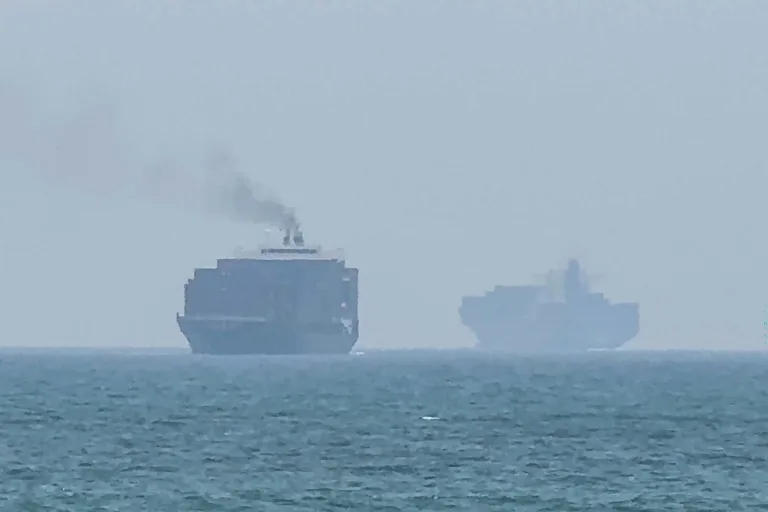
The American military launched a new wave of heavy air strikes against Iran on Sunday. The action followed renewed fighting over the strategic Strait of Hormuz, where several of Washington's Gulf allies came under incoming fire from Iranian forces. This latest flare-up severely undermines the fragile interim agreement between Washington and Tehran, which was designed to halt a war that has sent economic shockwaves across the globe since late February.
// RELATED STORIES

Suka dengan artikel ini?
Dapatkan lebih banyak informasi teknologi menarik dengan berlangganan newsletter kami. Gratis!
Subscribe Sekarang →According to U.S. Central Command, the latest salvo by American forces commenced at 2100 GMT on Sunday. This followed approximately 140 strikes conducted the previous night. Iranian state media reported that the American bombardments targeted expansive areas across southern and western Iran. The strikes hit Qeshm Island and Bandar Abbas near the strait, as well as Khuzestan province along the Iraqi border.
The renewed violence instantly rattled international markets. Oil prices, which had steadily declined following the announcement of the interim peace agreement, rose over 3.5 percent when futures trading opened on Monday in Tokyo. The American benchmark, West Texas Intermediate, jumped above $74 a barrel as traders braced for prolonged instability.
The escalation began early Sunday when Iranian forces attacked a commercial vessel in the Strait of Hormuz, forcing the crew to abandon the burning ship. Following the incident, Iran's Revolutionary Guards announced via the state news agency IRNA that "the Strait of Hormuz will be closed until further notice and until the end of American interventions in this region." Control of the waterway remains a critical lever for Tehran, with an adviser to the supreme leader stating it holds more strategic value than "dozens of atomic bombs."
U.S. Central Command countered the Iranian declaration directly on social media, asserting that the strait remains "open to all vessels seeking to lawfully transit." The military command stated that American forces are "positioned and prepared to ensure" freedom of navigation, adding firmly that "Iran does not control the strait. Traffic is flowing."
Diplomats and international mediators are working urgently to salvage a peaceful solution after U.S. President Donald Trump declared the ceasefire over last week. Iran's foreign ministry condemned the new operations, stating that the American attacks "caused the return of insecurity in the Strait of Hormuz" and "have rendered futile all efforts" aimed at establishing lasting peace in the region.
The human cost of the conflict continues to rise. Iranian state media reported that at least 10 projectiles struck Qeshm Island, while separate strikes on the island of Farur killed a telecommunications worker and wounded two others. Early Monday morning, IRNA reported that American strikes killed one person and wounded four at a water pumping station in the southwestern city of Mahshahr.
The regional fallout spread rapidly as neighboring nations reported incoming fire. Kuwait announced that three of its northern land border posts were damaged and an offshore drilling platform was targeted by a hostile drone, leaving one person injured. Sirens and explosions echoed across Qatar, the United Arab Emirates, and Bahrain, while Jordan reported that three Iranian missiles landed within its borders.
In a rare diplomatic move, Oman summoned the Iranian ambassador to deliver a formal protest after the Revolutionary Guards targeted Omani territory. The strike occurred just hours after Muscat hosted Iran's foreign minister for crisis talks regarding the strait. Omani authorities later rescued 23 crew members from a burning Cyprus-flagged container ship, though New Delhi reported one Indian sailor remains missing.
The rhetoric between Washington and Tehran has reached a fever pitch. Iran's Supreme Leader Mojtaba Khamenei has vowed vengeance for the assassination of his father on the first day of the war. In response, President Trump stated that any attempt on his life would compel the United States to "completely decimate" Iran. Amid the rising tide of violence, UN Secretary-General Antonio Guterres demanded an immediate end to the hostilities, while Pakistani Foreign Minister Ishaq Dar emphasized that "dialogue and diplomacy remain the only viable path to resolving disputes."